Frostbite explained
Frostbite is a condition that occurs when skin and other tissues freeze due to exposure to cold temperatures, typically below 32°F (0°C). It can affect any part of the body, but it usually affects the extremities, such as fingers, toes, nose, and ears, as these parts of the body are farthest from the heart and have less blood circulation. During freezing, cell death is triggered by intracellular dehydration and direct damage to cell membrane by ice microcrystals.
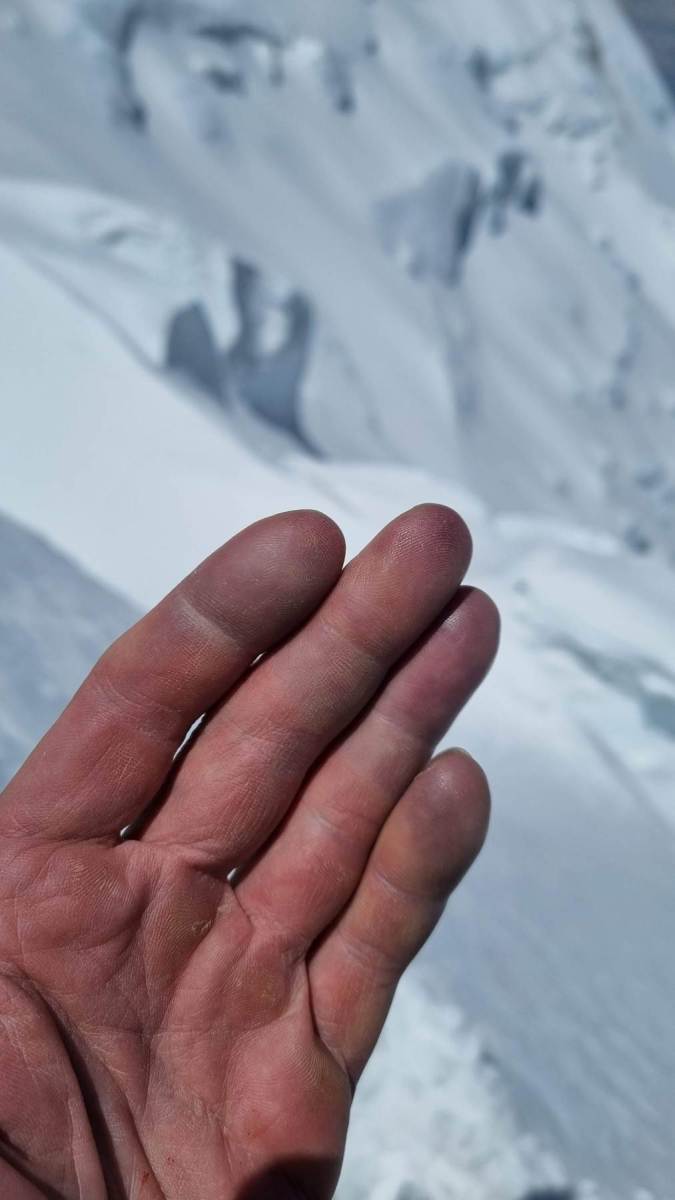
After prolonged exposure to cold, if the body parts are changing colour to more purple and blue it might be a sign of frostbite. You will feel a tingling feeling, numbness or pain in the body part.
The pain you feel from the cold in your toes can result in frostbite depending on the time, temperature and altitude. From my own experience about five hours of light to medium pain above 7400m towards 8000m resulted in the lightest frostbite when you feel a tingling feeling in the toes that goes away after a couple of months time.
It’s easier to get frostbite on high altitude, the lack of oxygen makes you less cold resistant.
This is a visual timeline of my grade three frostbite, from day one until 30 days post surgery. Sensitive viewers are advised not to look through this gallery.
The spectrum of damage on your tissue from suffering frostbite:
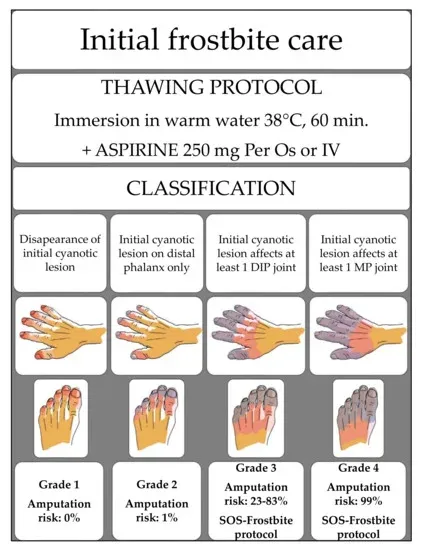
First-degree frostbite affects only the skin and causes redness, pain, and tingling. Potential nerve damage that recovers.
Second-degree frostbite affects the skin and underlying tissue and causes blisters, swelling, and a burning or prickling sensation. Potentially longterm or permanent nerve damage that makes exposure to cold more painful in damaged tissue.
Third-degree frostbite affects the skin, underlying tissue, and bone, and causes a complete loss of sensation in the affected area, as well as blackened or blue skin and muscle stiffness. Depending on the depth of the frostbite, ability to recover may vary from full tissue recovery with some permanent nerve damage to completly dead tissue that the body will start seperating from the healthy tissue after a couple of months. Natural demarcation zones will mark the separation of the dead tissue, surgery, partial amputation or full amputation is necessary.
Tools to help you deal with extreme cold.
Battery powered socks can help. I use socks from Lenz after my lighter frostbite on the toes and have avoided the same problem on my second 8000m climb without bottled oxygen. Note that the battery life have variations on different heated products and its advisable to have extra batteries and maybe even a powerbank.
Test your heated gloves or socks before the main objective so that you are familiar with the battery life and how long the batteries last with different settings.
From my experience the only time needed for the heated products are during night time summit push. Once its early morning and the sun comes out its no longer as important on high altitude climbs. Extra batteries can be a backup for unforeseen situations and emergencies.
What can you do if you got frostbite to minimise the long term consequences?
Acting on your frostbite injury and getting medical help as soon as possible is the most important action you can take regarding how much you will be able to recover of your body parts.
First acute treatment recommended is hot water. Dip your frozen body parts into hot water as soon as possible. Try to keep the water really warm during the full duration and try to stay in for about 40 to 60 minutes. Helps recover circulation and might save some of the damaged tissue.
If hot water is not available try to stay warm and hydrated. Get inside a sleeping bag, tent or dig a snow cave.
If you are on high altitude try to drop altitude because the oxygen levels will help your body to recover faster. Keep gloves mittens on at all times.
Keep your frostbitten joints straight for the first week, if its deep frostbite it might lock your joints into the position they are in and it can be very hard to recover the joint mobility afterwards.
Treatments once arriving at the hospital.
The affected body parts should be kept warm at all time with plenty of bandages or other insulation. Regular hot water treatments to bring back circulation.
I received Iloprost treatment to improve the circulation arriving at the Civic hospital in Kathmandu. Iloprost is a medication used to treat diseases in which the blood vessels are constricted and blood cannot flow to the tissues. During my four days using Ilioprost for six hours daily through intravenous infusion, we did see some improvement judging by the colour on the fingers. Looking back in hindsight I believe that we might have gotten even better results by extending the treatment for another two days and with a longer daily exposure.
It is not common that hospitals have Iloprost available so its always best to check this beforehand.
Hyperbaric treatment
Hyperbaric treatment, also known as hyperbaric oxygen therapy (HBOT), is a medical treatment that involves breathing pure oxygen in a pressurized environment, typically in a chamber. The pressure in the chamber is usually 1.5 to 3 times higher than normal atmospheric pressure, which allows the lungs to take in more oxygen than they would at sea level.
HBOT has a variety of medical uses, including treating decompression sickness (the bends), carbon monoxide poisoning, and wounds that are slow to heal, such as those caused by diabetes or radiation therapy. It has also been used to treat certain infections, neurological conditions, and long-term covid.
Other use cases are muscle recovery or wellness related benefits.
Medical HBOT chambers
The patient is placed in a clear acrylic chamber, which is then pressurized with pure oxygen. The patient may feel a fullness in the ears similar to what they experience during air travel, and may need to clear their ears by swallowing or yawning. The treatment typically lasts between 60 and 90 minutes.
Wellness HBOT chambers
These chambers are pressurized with regular atmospheric air. To maximise the oxygen intake you will use a mask that provides up to 97% oxygen.
In comparison to medical chambers you are not allowed to go above a certain pressure limit due to regulations and safety.
HBOT is generally considered safe, but it does carry some risks. These include damage to the ears or sinuses, changes in vision, and seizures. People with certain medical conditions, such as emphysema or lung collapse, may not be candidates for the treatment.
HBOT and frostbite
In Chamonix were they see the highest concentration of frostbite cases on the planet, HBOT has been standard treatment for severe frostbite with amputation risk.
https://healthcare-in-europe.com/en/news/chilled-to-the-bone.html
The studie below made in the same region has concluded that the combination of Iloprost and HBOT significantly improves the patients chances to avoid amputation:
https://www.mdpi.com/1648-9144/57/11/1284?fbclid=IwAR10RG3ldXs94-kF_HhLR0eHQHOB0Vm4V7EFjv5-d99eLJCfXFScVM90gWg
From my own experience I was able to recover three fingers fully from necrosis and both of my big toes. Another two fingers recovered significantly were I was able to keep almost full length. In total we had to make six partial amputations.
There is no hyperbaric chamber in Kathmandu so I had to wait six days after frostbite until I started my HBOT treatment with: https://oxywellness.se/ in my hometown Göteborg.
I was not able to access the higher pressure medical HBOT chambers in my home country due to full reservations and lack of scientific prof that HBOT helps against frostbite. I also lost more then 24 hours once arriving to my country while waiting for my appointment with the doctors. Luckily I found a private chamber.
Conclusion
The first week with grade 2 or higher frostbite, is were the majority of the recovery can be made as the tissue has not yet turned necrotic, it should be treated as an emergency because of the overhanging risk for amputations. From my understanding optimal treatment to maximise probability to avoid amputations would be constant hot water warming and Iloprost combined with medical HBOT.
Iloprost was not available in Sweden and might not be in many other countries.
Many countries do not have access to medical HBOT. If you suffer frostbite while climbing in Pakistan for example it might take several days and flights before you can reach a location with the optimal treatments.
From my experience, recovering skin tissue can take between 2 to 6,5 months. Necrotic tissue will start falling off by itself when skin underneath is healed. If necrosis (dead tissue) is removed to early it will be very hard or impossible to get new skin tissue to cover the area. I had alot of granulation tissue in the demarcation zones that made it very hard for new skin to grow across. The more skin you can recover the more of your fingers you will be able to keep post surgery.
Joint rehabilitation needs to start immediately in order to keep mobility in the joints. Joints can potentially freeze and become unusable depending on how deep the frostbite is.
I used HBOT twice a day between day 6 to 16 in my recovery, then gradually less over time. In total about 85 sessions. Unfortunately I did not have access to an HBOT chamber during the first week of my injury before my skin tissue turned necrotic.
I also tried PEMF therapy and red light therapy, its hard to measure if they had any significant impact on my recovery.
I might have one more surgery to fix or remove two nails depending on how they develop.
I will not be the last person suffering from frostbite so I wanted to share this information with all of you that spend time in the outdoors. It might save a fingertip or two in the future.
This is not medical advice its based on my own experience suffering all degrees of frostbite after spending a night outside without shelter above 7000m on Annapurna I. As a consequence I suffered from severe frostbite spread over 10 fingers and 4 toes with partial amputations on six fingers.
To support my recovery:
To follow my recovery and rehabilitation journey, find the links on the social media page.
Big thanks to everyone that have been there for me during this journey, I appreciate you all more then you know!